For over 4,000 years, Moringa oleifera, the “Miracle Tree”, sustained civilizations through famine, war, and disease. Ancient Egyptian pharaohs valued its oil so highly they were buried with it. Mauryan warriors drank its juice before battle. Ayurvedic texts prescribed it for over 300 ailments.
Then in 1913, Western scientists discovered vitamins. Within 30 years, companies like Roche, Merck, and Pfizer built billion-dollar empires by isolating and patenting individual nutrients. The problem? Moringa already contained them all—naturally, abundantly, and freely available.
One tree produces leaves with: → 10X more protein than spinach → 5X more Vitamin C than oranges → 3X more beta-carotene than carrots → All 9 essential amino acids → Higher calcium density than milk → More iron than spinach
 You can’t patent a 4,000-year-old tree. You can’t generate recurring revenue from something that grows for 20 years from a single planting. So while pharmaceutical companies lobbied governments to fortify food with synthetic vitamins, Moringa was quietly marginalized.
Moringa refers to Moringa oleifera, a fast-growing tree native to parts of South Asia and now cultivated widely across Africa, Latin America, and the Caribbean. It is often called the “drumstick tree,” “miracle tree,” or “tree of life” because nearly every part of the plant is usable and nutrient-dense.
What Moringa Is
Moringa is a plant-based superfood and medicinal tree whose leaves, seeds, pods, flowers, and roots have been used for centuries in traditional medicine systems such as Ayurveda.
The leaves are the most commonly consumed and researched part.
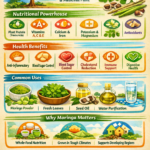
Nutritional Profile (Leaves)
Moringa leaves are exceptionally rich in nutrients relative to their calorie content:
-
High-quality plant protein (contains all 9 essential amino acids)
-
Vitamin A (beta-carotene)
-
Vitamin C
-
Vitamin E
-
Calcium
-
Iron
-
Potassium
-
Magnesium
-
Powerful antioxidants (quercetin, chlorogenic acid, polyphenols)
Because of this density, moringa is often marketed as a whole-food multivitamin, particularly in regions with malnutrition.
Health Benefits (Evidence-Based & Traditional)
Research and traditional use associate moringa with:
-
Anti-inflammatory effects
-
Antioxidant protection (reduces oxidative stress)
-
Blood sugar regulation
-
Cholesterol reduction
-
Blood pressure support
-
Immune system support
-
Digestive health
-
Liver protection
It has also been studied for potential anti-bacterial and anti-fungal properties.
Common Uses
-
Powder (added to smoothies, teas, capsules)
-
Fresh leaves (cooked like spinach)
-
Seed oil (“ben oil” used in cosmetics and cooking)
-
Seeds (water purification in some regions)
Safety and Considerations
-
Leaf products are generally safe when consumed in normal dietary amounts.
-
Roots and bark contain compounds that can be toxic in large doses and are not recommended for regular consumption.
-
People who are pregnant, on blood pressure medication, or blood sugar–lowering drugs should consult a healthcare professional before regular use.
Why It Gets So Much Attention
Moringa stands out because it:
-
Provides broad-spectrum nutrition from a single plant
-
Grows in harsh climates with minimal water
-
Offers both nutritional and economic value in developing regions
Bottom Line
Moringa is a highly nutrient-dense plant with legitimate health benefits, especially as a dietary supplement or whole-food nutrition source. While it is not a medical cure-all, it is one of the most comprehensive plant-based nutritional resources known.
If you would like, I can also provide:
-
A comparison to synthetic multivitamins
-
Scientific studies and citations
-
Best dosage and forms to use
-
Marketing-ready explanations for wellness branding